Showing posts with label SSIF. Show all posts

Friday, 25 January 2019

SSIF Training: Closing The Vocabulary Gap

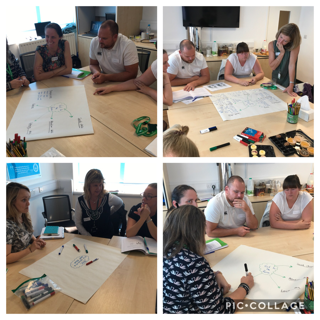
On Monday 21st January, we hosted a training day, focusing on 'Closing the vocabulary gap in year one'. This training was lead by a consultant from Oxford University Press, for the benefit of Year 1 Teachers and Teaching Assistants.

Throughout the day, participants got to:
  • explore theory and practice, including the key principles of vocabulary extension
  • supporting the selection of appropriate, engaging and motivating texts
  • identifying and supporting strategies that facilitate word learning
  • developing an understanding of word consciousness through rich oral language experiences.
This training was put in place to build on the support children had been receiving as part of the SSIF project being implemented through the Teaching School.
Whilst out visiting school this week, it was pleasing to hear that schools have already started implementing strategies that were explored during the training.


Monday, 14 January 2019

TA Training - Nuffield Early Language Intervention


On Friday, we welcomed back our TAs who are implementing The Nuffield Early Language Intervention across 15 school as part of the Strategic School Improvement Fund project. The project is a third of the way through and is now in the final 10 weeks. The project continues to be successful due the commitment, self reflection and knowledge that the TAs are bringing to the project.

The Nuffield Early Language Intervention is an evidence-based oral language intervention for children in nursery and reception who show weakness in their oral language skills and who are therefore at risk of experiencing difficulty with reading. It is delivered over 30 weeks by teaching assistants in groups of 3-4 children.

The intervention was developed by a team from the University of York, who subsequently carried out a randomised control trial in 15 schools and feeder-nurseries across Yorkshire. After 30 weeks, the children who had received the intervention had improved expressive language skills, including the use of vocabulary and grammar. Their letter-sound knowledge and spelling also improved, indicating the foundations of phonics were in place.


Monday, 3 December 2018

CPD Training with Pete Moorhouse

We were delighted to welcome Pete Moorhouse to Mead Primay School to deliver day 2 of our Vision to Provision programme. This was a fantastic opportunity for Havering's EYFS Leads to take part in some fantastic CPD funded through Havering Primary Teaching School Alliance. With 37 schools represented, we look forward to seeing how woodwork develops across the curriculum throughout the year. Pete will be back to join us for a final conference in May.
Pete Moorhouse is passionate about encouraging creative thinking in Early Years Education. He has over 25 years experience working with schools.
Pete is the leading authority on Woodwork in Early Years Education and has several journal articles and books published. Pete is an  Honorary Research Fellow at the University of Bristol currently researching Creativity and Critical thinking in Early Years Education. 
Pete is dedicated to providing opportunities for all children to express their creativity and develop their creative and critical thinking skills, and firmly believes in narrowing the gap in attainment and improving outcomes for all children.


Monday, 1 October 2018

SSIF project: SLE Training Day 3


Today the Early Years SLEs completed their third day of training to support our Strategic School Improvement Fund project. SLEs from across our borough and from The London Borough of Redbridge came together to complete the Elklan Speech and Language support training for 3 - 5s, lead by Sarah Dunne. This level of intensive training will enable the SLEs to support in schools not only with the NELI intervention but to also support the wider provision to enable schools to become Communication Friendly. 


Thursday, 19 July 2018

SSIF Intervention Group

The NELI project - which is only possible due to the Strategic School Improvement Fund - is now underway in 15 schools. Pupils are getting access to five days a week of communication and language support.

The aim is to see more disadvantaged pupils managing to reach the exceeding expectations for the end of EYFS. Havering typically has very strong results with expected outcomes. However we don't see as many pupils reach the higher level - particularly those from disadvantaged backgrounds.

It is already having an impact on their narrative skills. At the start the children were using less that 15 words to respond to a stimulus. They weren't confident with their connectives and the range of information contained in the talk was limited. So far we have seen improvement if 20%+.
A Pidgeon - SLE

It has also been a great vehicle for looking at the wider setting and how language can be improved in all areas.

  • Do all staff have the same expectations for an effective narrative - explanation beyond one sentence?
  • Are instructions given clearly by all staff?
  • Are pupils given thinking time to process their response?
  • Do you see adults modelling vocabulary that you want the pupils to be able to use?
  • Are verbs promoted as much as nouns are?


Tuesday, 17 July 2018

DfE Visit to SSIF

We were delighted to welcome Alex Birkhamshaw - from the Department for Education - to come and see the NELI project in action.

The children were very excited to give a demonstration of their listening skills and show how they were able to handle the vocabulary that Mrs Mackman was giving them.

Specialist Leaders are making weekly visits to the focus schools to support the Teaching Assistants in the delivery of the intervention.

The weekly support has been so helpful. My SLE has supported my reflections on what I need to tweak to make the next session more effective. 
Teaching Assistant

It has also been great to see the support from Governors, who have attended the information sessions. It has made it more likely that EYFS outcomes will be championed at a Governing Board level and that the impact of the project will be sustained beyond July 2019.


Thursday, 31 May 2018

SSIF Project: SLE Training

Our Strategic School Improvement Fund project launch is now entering the last phase. Having gone through the aims of the project with Headteacher’s, and trained the Teaching Assistants who will deliver the NELI intervention we have now spent two days with our SLEs.

These Early Years specialists will be responsible for supporting the target schools:
  • coaching the Teaching Assustant
  • collecting assessment and impact data
  • supporting reflections on the wider EYFS environment 
The SLEs from Broadford have been joined by leaders from Mead, Gearies, Clockhouse & Hilldene Primary. 

I am really excited at the opportunity to go and work with other settings and see this intervention in action!
C Tynan

Communication is such an important aspect of the Early Learning Goals. I am fully behind the aims of the project to improve outcomes across Havering. 
K Edwards

As the project progresses we will keep updating you on the impact that the NELI intervention is having. 


Monday, 30 April 2018

SSIF: Vision 2 Provision Conference

36 Havering Schools cake together to review the progress so far of our new Vision to Provision programme for Early Years leaders and settings.

What is the rationale for V2P?
Havering data shows that Expected outcomes are strong and improving. However Exceeding outcomes - particularly with Communication - are significantly behind. 

How did this session help?
The aims of this season were:
  • to share with HTs and their EYFS leads the tweaks that have been made to approaches in their settings this year and the impact they have had
  • give HT support with interpretating their EYFS data and being able to provide challenge and support for their EYFS leads
  • look ahead to 2018-19 and how we can develop the programme further to meet the needs of Havering settings
Julie Fisher - Who Leads The Learning?
Julie Fisher then led the remainder of the day, exploring how adult/child interactions can be made more effective. 

I have been inspired by each session on the V2P course and think it has been a great source of knowledge, understanding and ideas for leadership. I particularly enjoyed Julia Fisher's talks and found them very inspirational!

From my perspective I think the course has been perfectly pitched. It has had a significant impact on me as a Head with no expertise in EYFS, in terms of strengthening and developing my understanding and as a consequence facilitating a much stronger relationship between senior leaders and Early Years. It has really helped us to further shape and refine our vision for our EYFS setting.

I think it has helped our EYFS lead to feel more secure in her leadership abilities. The programme has provided her with the opportunity to reflect on her practice and the practice of others.

We look forward to welcoming EYFS Leads back for the final session of the year on June 8th @ Mead Primary.


NELI Training Day 1

Mead Primary hosted the first day of the NELI Training as our launch phase of the project progresses.

First the Teaching Assistants will learn how to deliver the intervention. This involves:
  • three weekly group sessions of 20-30mins
  • two individual sessions for each pupil per week
Using stimulus cards, the TAs will support the children in extending their narrative ability. By providing simple clear guidance on how to scaffold a narrative, we aim to improve the pupils’ attainment across Listening & Attention, Understanding and Speaking.

The feedback from the training has been extremely positive:
A very well run training session that means I am very confident I will be able to deliver this in school

The resources and manual are really helpful. Often we are left to plan dna resource interventions ourselves - this is so much clearer

Our trainer - Sarah - really made me think about the way we speak to the children and model language. This intervention will help the whole setting

100% agreed that they would be confident at starting the intervention
100% agreed that they understood the aims of the SSIF project

We now can’t wait to see the impact that the NELI resources will have! 


NELI Resources

This morning the delivery man dropped off the boxes for the Nuffield Early Literacy Intervention (NELI).

Without the funding from the SSIF, Havering schools would not be able to afford either the resources or the training that will make such a difference to our Early Years pupils.

We aim to diminish the difference in communication outcomes so that Havering produces more Exceeding pupils - particularly those from disadvantaged backgrounds.

Included in the pack is:
  • a manual of the program so that Teaching Assistants don’t have to plan, only prepare their sessions
  • all of the flash and prompt cards
  • a teddy hand puppet
The resources and scheme look really engaging. I am confident that the simple framework that it provides for improving talk and conversations will have a real impact on our pupils. 
J Mackman


Strategic School Improvement Launch Event

All 15 schools who will be part of the Havering SSIF bid attended the Launch Event this month. The intention was to ensure that HTs, Governors and EYFS Leads were all aware of the key priorities of the project and how it would be delivered.

In partnership with ELKAN, Oxford University Press, the Department for Education, Havering Education Services (HES) and Broadford Primary, the project will reach over 2,000 children between now and July 2019.

Step 1: Launch the event to HTs, Governors and EYFS Leads
Step 2: Train the Teaching Assistants in the delivery of the intervention
Step 3: Launch the programme in schools and collect baseline data
Step 4: Train the SLEs in their role of support and challenge for wider adoption of the principles
Step 5: SLEs to get into schools and provide ongoing weekly support as pupils progress through the NELI intervention.

A really clear project. I understand the aims and believe that this will really be of use to our setting.

The support from the SSIF is amazing. Our CPD budget is limited. Without this funding we wouldn't be able to participate.

We now look forward to getting the training underway and seeing the intervention in the classroom


Thursday, 29 March 2018

Vision To Provision: Conference Day

We are looking forward to welcoming you to our second full day Vision to Provision conference:

Date: Monday 16th April
Venue: CEME Centre RM13 8EU
Time: 9am - 3pm (coffee available from 8.30am)
Lunch: Provided for free
Booking: Please use the Havering portal to book your place
Audience: Headteachers & EYFS Leads

This will be an opportunity for Headteachers and EYFS Leads to plan on how they will work together to ensure that assessment data submitted accurately reflects the cohort and links to Havering priorities - which were identified at the first Conference in October.

We also want to take this chance to inform you about the plans for Vision 2 Provision 2018-19 as it will run again but with updated and different content.

Julie Fisher will lead the majority of the day, giving Headteachers and EYFS Leads a chance to reflect:
  • on the role of adults within their settings
  • how to develop effective interactions
  • think ahead to 2018-19 and what their next steps are going to be for their settings
Feedback from the first Conference in October was extremely positive:
'The colleagues we heard from were really inspirational and all of the messages/advice was really useful. Thank you.

'It an intense but enjoyable and reflective day'

'I thought it was excellent; pitched perfectly with good speakers and good content. Very inspiring.'


Saturday, 3 March 2018

Improving Vocabulary in EYFS

If we want to close the vocabulary and attainment gap that already exists by the age of 3, we need to seriously reconsider our practice. Some children will require a more targeted approach for speech and language development but targeted doesn't have to mean boring. However a huge percentage of supporting behaviour and communication is done by following what a child is interested in and adapting the learning there and then to their specific level of need. When you get down at their level and you follow a child’s lead, you can really enhance their vocabulary / enrich their learning.

Here is a scenario where a great opportunity to develop speech and vocabulary is missed:
A little girl comes into the nursery and finds her name for self-registration (or rather the picture next to her name. She’s only just turned 3.) Her picture is a kite, which just so happens to be the school emblem so we all have one on our t-shirts. 
The EYP says “look what you’ve got! It’s the same as mine. I have one on my t-shirt.” All credit to the EYP, she didn’t ask “what is it?” The staff know I dislike boring test questions. But I was curious, so I asked the girl and of course she didn’t know. Because not once during her self-registration had she heard from her mum, or the EYP “it’s a kite. You’ve got a kite. I’ve got a kite too. It flies in the sky when it’s windy.”

Yes, the EYP was interacting with the child, getting down at her level and even following her interest. But the child left that interaction with no more vocabulary than when she came in.


These tips would be a good starting point:
  • With every nursery activity (such as circle time) consider... is every child benefitting from this activity? Or is it the same chatty few that are participating every time? What changes could be made to ensure every child is included? This might mean smaller groups, shorter time in a circle or adapting your language and expectation according to their need.
  • Does every child start with a clean slate every day? Or does your staff use langauge such as "I hope we are going to have a better day than yesterday."
  • If a child is "misbehaving" (also known as 'has not received the memo of what your expectations are for the day.') was the activity chosen and led by them...or you?
  • If a child is "misbehaving," do they actually understand what is expected of them? Or do you need to support that understanding by using visuals, gestures or simplifying the instruction?
Read the full article here

Child Led Learning & Speech & Language