Saturday, 16 June 2018

How do I become a leader?

Have you ever had a teacher ask you...

"Make me a leader"

In response to this you may reply with "What do you mean... what are you lacking?"

Often their reply would be that they feel they lack authority and would like to be able to tell others what to do. However when the teacher is then challenged to list all the times that the Headteacher or SLT has directly told them what to do... when they feel they have been ordered around... often they cannot think of many examples at all.

It would be a painful day to day experience of leaders relied on their authority to work with staff.

Which brings us back to the original question

"So what do I need to do to become a leader, then ?"


Monday, 11 June 2018

Forget the mistake, remember the lesson.


Leaders do not need to be perfect. They need to be inspiring.

Do you have a healthy environment at work where people are not afraid to take responsibility for failures and mistakes? Rapid learning and progress are more likely to be made if the culture remembers the lesson and not the mistake.

In such schools there is no fear - only respect.

In such schools teachers are not expected to be perfect - the expectation is to be creative, energetic, supportive and helpful.

Nobody is perfect.

It all starts with leadership. Do you show that you aren't afraid to be open about your own imperfections, shortcomings and mistakes?

Saturday, 9 June 2018

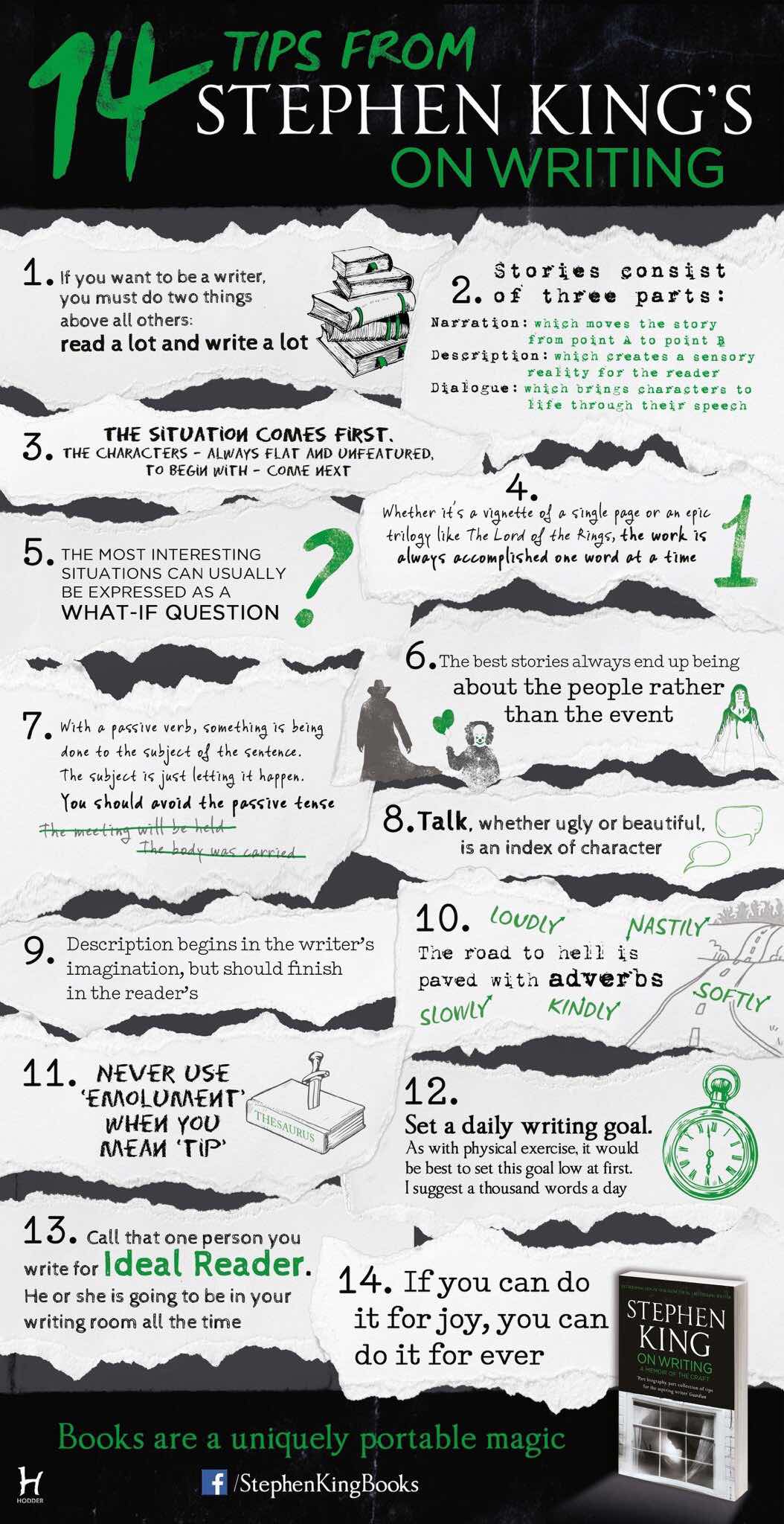
Stephen King Writing Tips

Stephen King’s books have sold over 350 million copies. Here are our favourite pieces of advice for aspiring writers:

First write for yourself, and then worry about the audience. “When you write a story, you’re telling yourself the story. When you rewrite, your main job is taking out all the things that are not the story. Your stuff starts out being just for you, but then it goes out.”

Avoid adverbs. “The adverb is not your friend. Consider the sentence “He closed the door firmly.” It’s by no means a terrible sentence, but ask yourself if ‘firmly’ really has to be there. What about context? What about all the enlightening (not to say emotionally moving) prose which came before ‘He closed the door firmly’? Shouldn’t this tell us how he closed the door? And if the foregoing prose does tell us, then isn’t ‘firmly’ an extra word? Isn’t it redundant?”

Don’t obsess over perfect grammar. “Language does not always have to wear a tie and lace-up shoes. The object of fiction isn’t grammatical correctness but to make the reader welcome and then tell a story… to make him/her forget, whenever possible, that he/she is reading a story at all. “

Read, read, read. “You have to read widely, constantly refining (and redefining) your own work as you do so. If you don’t have time to read, you don’t have the time (or the tools) to write.”

Turn off the TV. You must be prepared to do some serious turning inward toward the life of the imagination. Reading takes time, and the glass teat takes too much of it.”


Wednesday, 6 June 2018

Cognitive Bias - are you aware?

What is cognitive bias?
A cognitive bias is a mistake in reasoning, evaluating, remembering, or other cognitive process, often occurring as a result of holding onto one's preferences and beliefs regardless of contrary information. 

Psychologists study cognitive biases as they relate to memory, reasoning, and decision-making.

What might cognitive bias look like in education?
The Hawthorne effect

This is named after an experiment at the Hawthorne Factory in the US.

Keen to find out how their staff could be more productive, the owners of the factory observed them. Knowing that they were being watched, the employees worked much harder and productivity increased. When they were no longer being observed, productivity returned to normal rates.

This has some interesting implications for teacher observations, as it is difficult to give someone feedback on how they are doing if your mere presence alters how they act. Having regular low-stakes observation that focuses on feedback rather than judgement should go a long way to remedying this.

Likewise, if pupils are undergoing an intervention to improve a particular area and they know they are part of an intervention, it will probably impact their subsequent behaviour. This is why subtle and stealthy interventions are likely to have greater impact.

Read the full article here


Monday, 4 June 2018

Leadership - It is not all about me!


One of the greatest things about leadership is that we all bring something different to the table. If you were to read articles on good leadership qualities, you would usually see factors like integrity, effective communication and influence. These are all wonderful qualities of a leader, but to stand out as a leader —you need to put people ahead of yourself.


Image result for leadership  images

Saturday, 2 June 2018

Profile of Women - Star Wars not yet groundbreaking!

Even in a movie where the protagonist is a woman, Star Wars is still biased towards male actors.

A new study has ranked the Star Wars films by the amount of time given to female characters – and the original 1977 movie is at the bottom of the pile.

According to Glasgow University lecturer Dr Rebecca Harrison, in Episode IV: A New Hope, women (a category which here includes female robots and aliens) get just 15 per cent of the film's screentime.

Explaining how she arrived at the figures in a blog post, Harrison said that non-speaking characters were not included, and that the definition of "women’s screen time" excluded scenes in which women appear in the background while men talk, or in a purely passive role as a "visual object".

The most recent film included by Harrison, 2017's The Last Jedi, comes top with 43 per cent.

The ranking: Star Wars films by women's screen time
  • 43% Episode VIII: The Last Jedi
  • 37% Episode VII: The Force Awakens
  • 35% Rogue One: A Star Wars Story
  • 23% Episode VI: Return of the Jedi
  • 22% Episode V: The Empire Strikes Back
  • 20% Episode I: The Phantom Menace
  • 18% Episode II: Attack of the Clones
  • 17% Episode III: Revenge of the Sith
  • 15% Episode IV: A New Hope

Friday, 1 June 2018

Marginal gains


Small changes that make a big difference to your teaching


Teachers can learn a lot from the world of competitive sports when it comes to making small changes to improve their practice, says this head of department.

When it comes to education, we are the professionals. We are the elite and the experts who can benefit from this level of fine tuning. Once we have got the basics right, we can look for those small tweaks to our practice that might not seem like much on their own, but as a combination could make a huge difference to the children we teach.

Read the full article here

Image result for rowing team  images