Monday, 19 February 2018

LEAD!: Middle Leadership Development

Last chance to book onto the first of the Middle Leadership development sessions which start on February 22nd.

This course is broken into three chapters: leadership of self, leadership of others and personal reflection. By the end of the sessions you will have:

  • a clearer sense of your own leadership styles and when to apply them
  • a range of strategies to lead teams more effectively
  • tools and tips to aid your ongoing professional development
Please book your place by emailing: bookings@teachingschool.havering.sch.uk


Sunday, 18 February 2018

Retaining Staff - 3 Tips

At this time of year school leaders will be planning for September. Staff will be thinking of where to be next academic year. As a school leader, have you ever lost a great teacher?

The moment you receive their resignation can take you by surprise. However their thought process that led to them resigning most likely happened months. 

When you are leading an organisation it is all too easy to get caught up in the now... absence, daly arrangements, cover, parents, meetings. But if you allow your head to drop and focus on the now, without paying attention to how some of your staff may be wanting to know about the future you can find that there is an erosion of emotional engagement. 

Staff turnover is costly: replacing someone costs a minimum of 6-9 months’ salary. And that’s just the hard costs. There’s also the cost to morale, the classroom impact, and the burden on the school leader trying to fill the gaps, while key initiatives fall further behind.

What can you do as a leader? A lot, and it starts with language. Employees may say they’re leaving for higher pay. There are funding pressures that mean this is always going to feature. In schools of all sizes there are only so many positions that offer additional responsibility. However there are other factors which can be managed. These can be key to maintaining engagement. 

Here are three no cost ways school leaders can keep people engaged:
  1. Feedback – Employees lose their emotional connection quickly when there’s no feedback from their school leader. Companies that implement regular employee feedback have a 14.9% lower turnover rate (HubSpot). Shouting “do better” six times a day doesn’t count. It’s simple; when an employee does a good job, tell them.
  2. Meaning – If you treat your employees like a number they’ll return the favor. They’ll treat their job like a transaction. Teachers who derive meaning and significance from their work were more than three times as likely to stay with their schools — the highest single impact of any variable according to a global study from Tony Schwartz. It costs you nothing to tell an employee how their actions make a difference to the team, your customers, or the world at large... don't take it for granted.
  3. Horizon – When people don’t know where the company is going or where their job is going, there’s no connection to the future. Make a practice of sharing your future vision, and tell your team what’s on the horizon. 

Saturday, 17 February 2018

Greater Depth In Writing - Alan Peat

Are you looking to develop staff confidence with teaching for Greater Depth in Writing?

Would you like to pick up some simple tips on how to implement the 'pupil can' statements into lessons?

Has your school been looking for inspiration to improve writing outcomes for pupils?

On March 22nd we are delighted to be welcoming Alan Peat to the Havering Primary Teaching School to provide an afternoon session on 'Working At Greater Depth in Writing'.

Please see the flyers below for more information and booking details.

Date: March 22nd
Time: 1-4pm
Venue: Mead Primary, RM3 9JD
Booking: info@alanpeat.com


Lead Like An Eagle

“One man can make a difference, but a team can make a miracle.” 

These were the words of wisdom that Eagles head coach Doug Pederson delivered to kickoff what became his unforeseen – unbelievable – championship winning season. If you weren't aware, this February the Philadelphia Eagles won their first Super Bowl... against the odds.

What is particularly interesting about their story is the way in which this championship team, and their leadership, benefitted from the power of emotional intelligence on their road to victory. So how could we learn some lessons from this remarkable achievement, and how could you begin to incorporate them within your own teams to achieve success?
  1. Practice self-awareness in order to achieve emotional intelligence.
  2. Exercise empathy – put yourself in your team member’s shoes, look through their lens.
  3. Create a culture of transparency – stay visible and grow trusted by your team. 
  4. Invest time in the relationships you have with your team members and give freedom for relationships to grow between them. 
  5. Never allow adversity to get you and your team down – change the narrative to see challenges as opportunities.
  6. Provide a purpose higher than self. Give your team the opportunity to align with something mission-driven, it will elevate them.


Sunday, 4 February 2018

Lessons from Bookcases

Across our Learning Federation, the mantra is to be continually evaluating practice, looking for marginal gains and trying to be better today than we were yesterday.

One company that has a rigorous approach to reviewing and refining processes to ensure constant improvement is IKEA.
Constant Tweaks
In 2010, for example, Ikea rethought the design of its Ektorp sofa and made the armrests detachable.

That helped halve the size of the packaging, which halved the number of lorries needed to get the sofas from factory to warehouse, and warehouse to shop. And that lopped a seventh off the price.

The Bang Mug
IKEA changed the height of their iconic mug when it realised it could make slightly better use of the space in its supplier's kiln, in Romania.

And tweaking the handle design made them stack more compactly - more than doubling the number you could fit on a pallet, more than halving the cost of getting them from the kiln in Romania to the shelves in the shop.

Billy Bookcase
It has been a similar story with the Billy bookcase. It does not look like it has changed much since 1978, yet it costs 30% less. That is partly due to constant, tiny tweaks in both product and production method.

Click here to read the full article

  • What systems and processes do you have that could be refined?
  • Is there something that is good, that with a tweak, could become great?
  • Do staff waste time on low impact tasks that could be made more efficient?
  • How often do you purposefully audit and review the systems and processes used?


Saturday, 3 February 2018

Purpose and clarity... and impact!

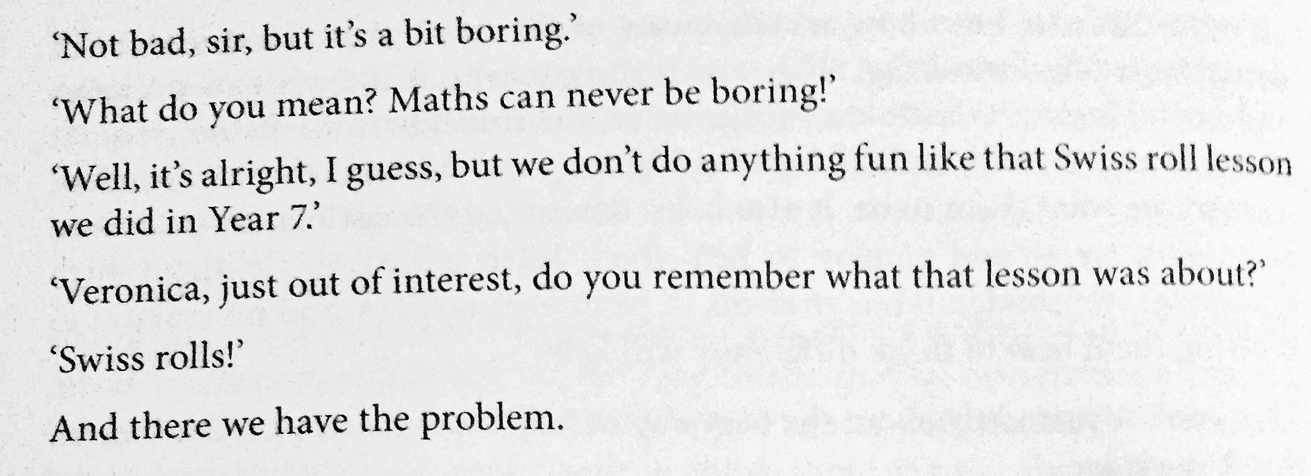
Often our SLEs have worked with teachers who have tried to tackle the issue of engagement in their classes. Often a solution can appear to be having a really WOW activity: slime, chemical reactions, pizzas into fractions... swiss rolls.

However, engagement isn't about having a small fireworks display to start the lesson. It is about knowing the objective that you wish to teach, knowing that it is appropriate and challenging for the class you have and then planning a purposeful activity that will allow the pupils to make progress towards it.

What is incredibly unhelpful is the lesson described below, that at the time was WOW... but no one can remember the point.


Thursday, 1 February 2018

Is it really that bad

There are always going to be times when the job seems overwhelming. Quite often it is all too easy to see only the problems and not realise that there is so much more around you that is going well. The image below is a useful reminder that it is rarely as bad as it seems: